
in
the
studio
with
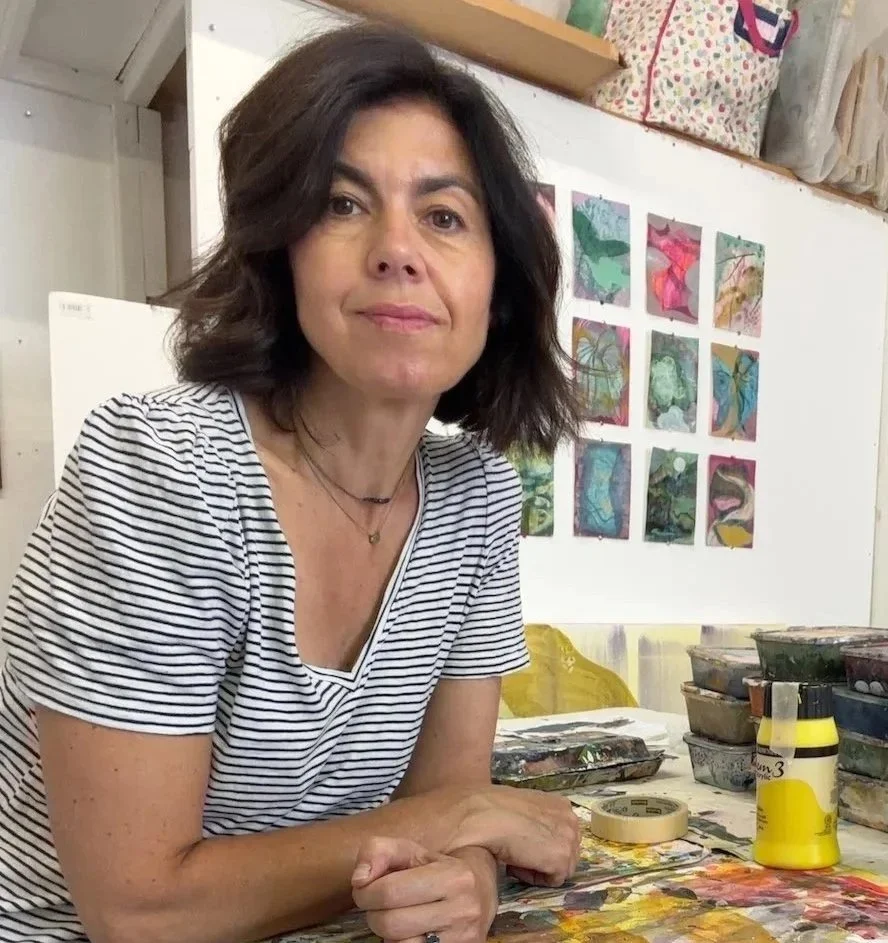
Justine Formentelli
interview by
Monica Perez Vega
and Sylwia Narbutt
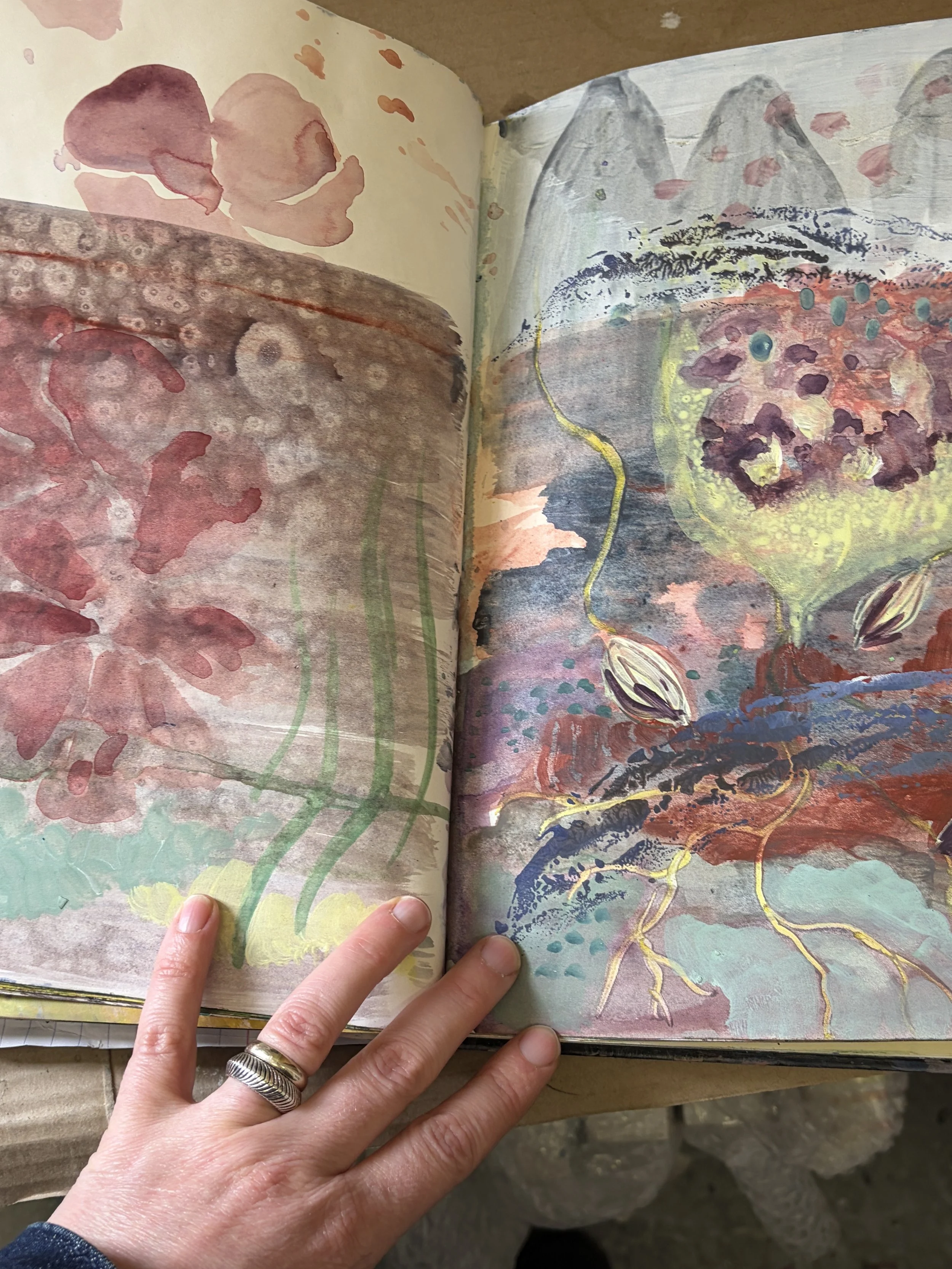
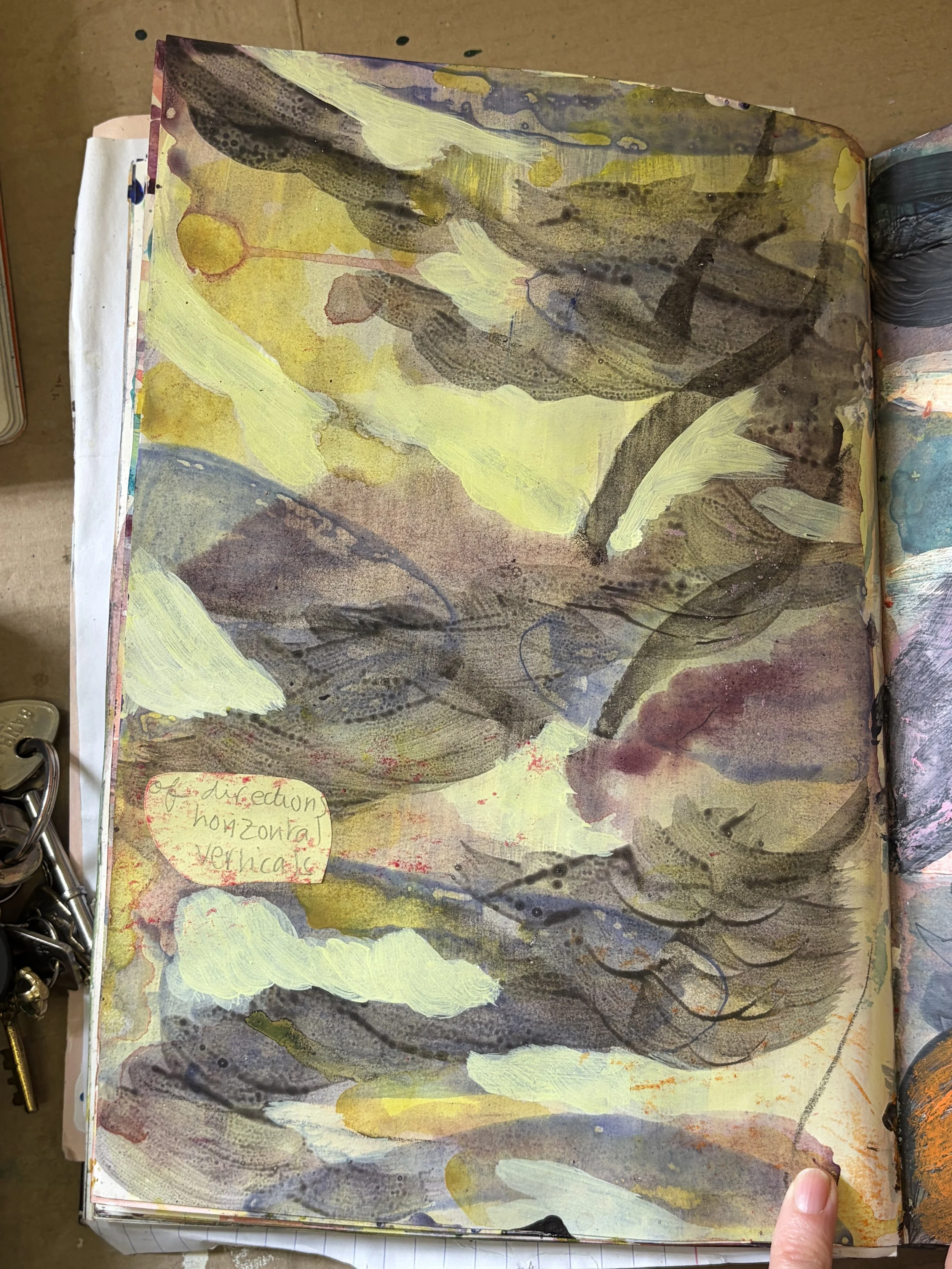
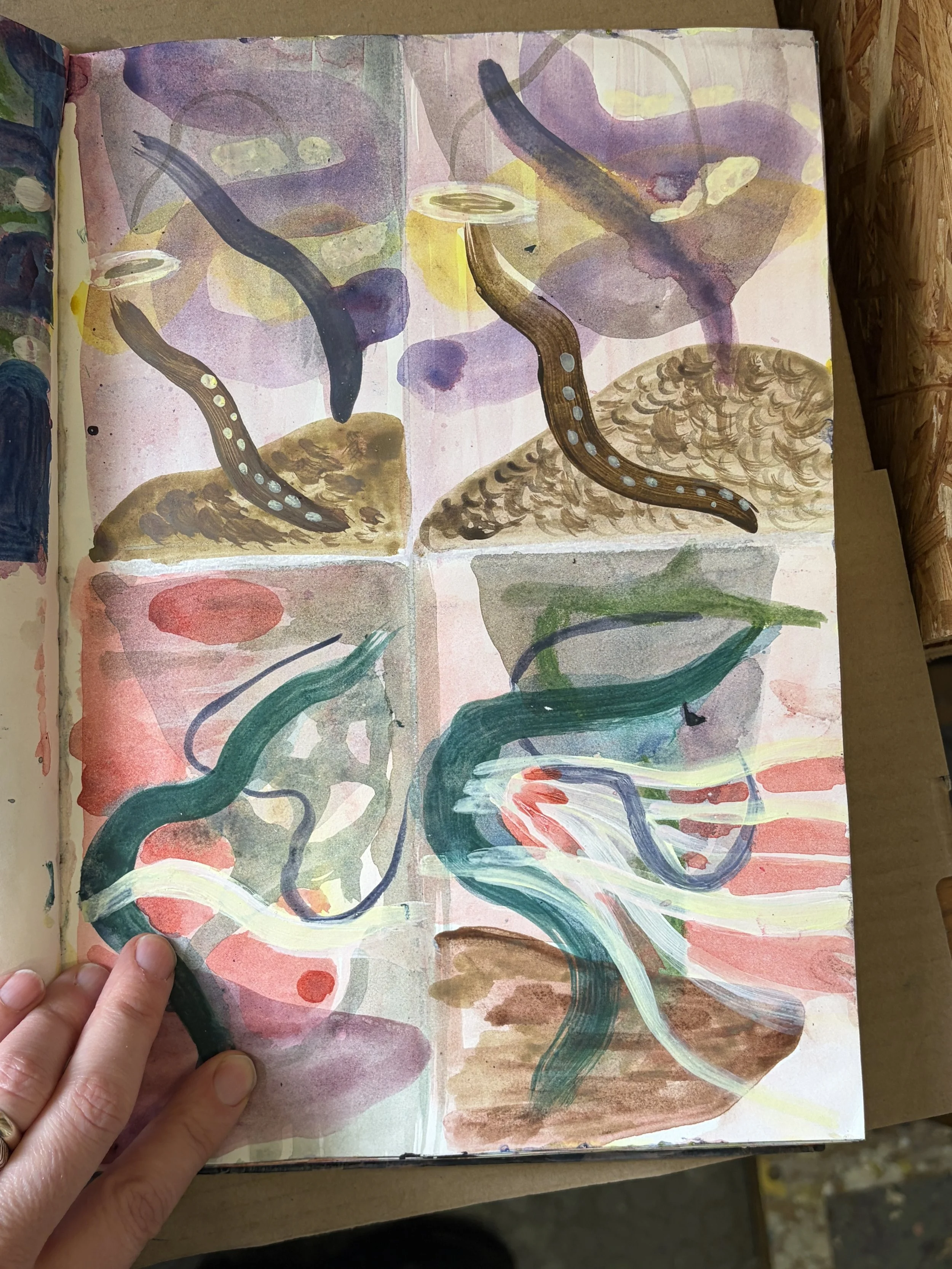
Justine Formentelli has been a long-time collaborator with Small Works CIC, participating in several of our group exhibitions, including Bury My Songs at Terrace Gallery in 2024, Seasons at Addenbrooke’s Hospital in 2025, and Women’s Day at Outhouse Gallery in 2026. Over the years, we have come to know Justine’s distinctive practice, with its rich, emotive layers of colour and texture. It was a pleasure to finally spend time with her in the studio and gain a deeper insight into the ideas, materials and processes that guide her work.
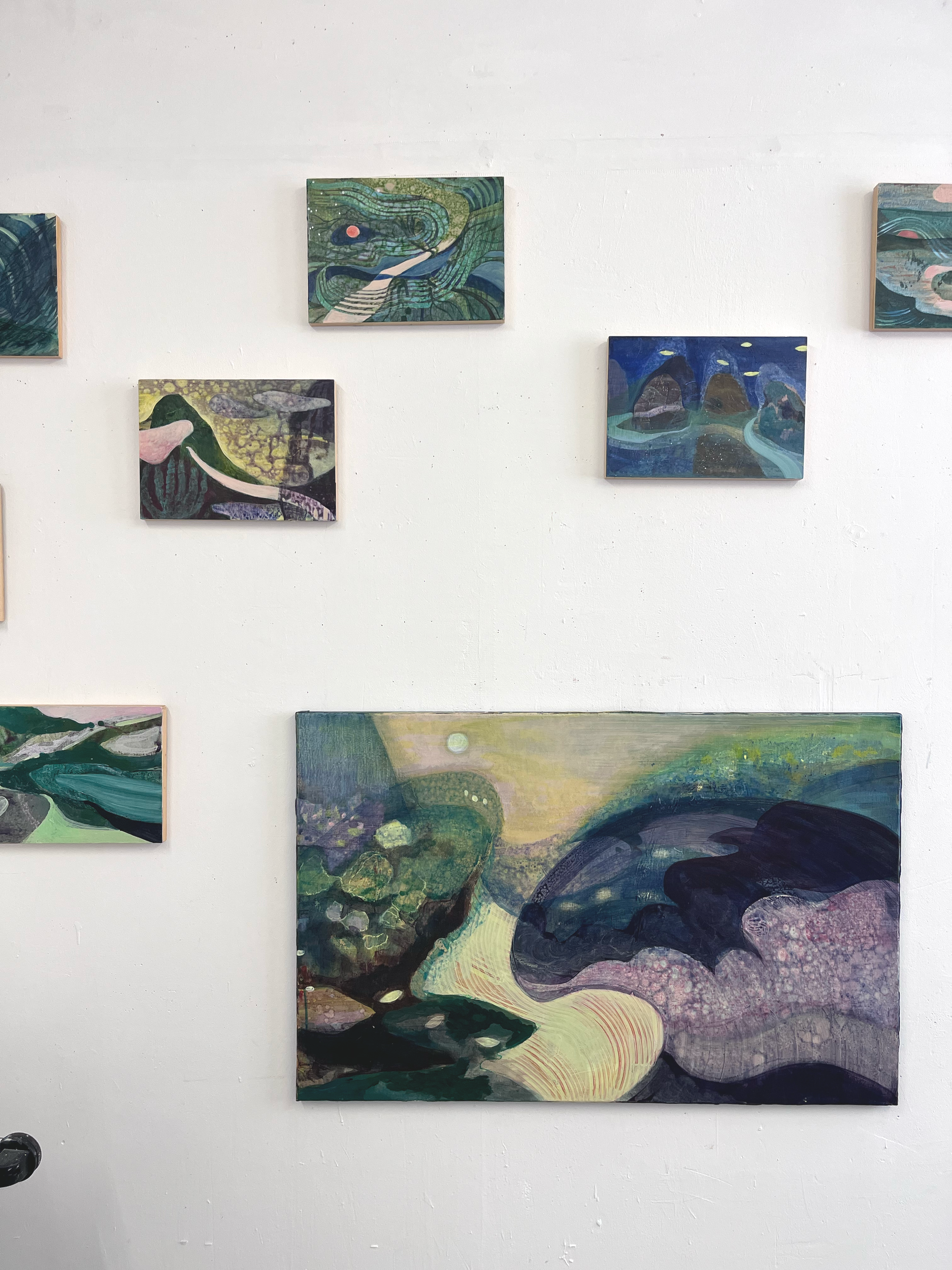
I love your term ‘intangible architecture’ and how your curiosity about what lies beneath the surface of things is reflected through layers and unexpected collisions of textures and materials. Where do you think this curiosity about people and the world comes from?
I have always been fascinated by what hides behind the façades people present to the world -what might be lurking in their most private basement, so to speak.
As a child, I was always trying to sneak into rooms where adults were talking in hushed voices. I was extremely curious about secrets and stories that were not meant to be heard by everyone, and especially not by children.
I think this appetite for complexity and dramatic narrative also comes from my love of literature. I was fascinated by books that revealed the complexity of people’s inner lives. I remember being deeply affected by The Diary of Anne Frank, which gave such immediacy to her private thoughts. As a teenager, I became completely engrossed in Émile Zola’s Rougon-Macquart series, where human frailties, desires and contradictions are described so vividly.
Living abroad and moving frequently also exposed me to changing environments and surprising discoveries. When I lived in the Medina in Marrakech, for example, we would make our way through a maze of dusty, dark alleys before arriving at our riad, where the light, plants, green ceramic tiles and open courtyard felt like an oasis. I loved that stark contrast between outside and inside. That sense that something unexpected might be concealed behind a wall or a closed door has stayed with me.
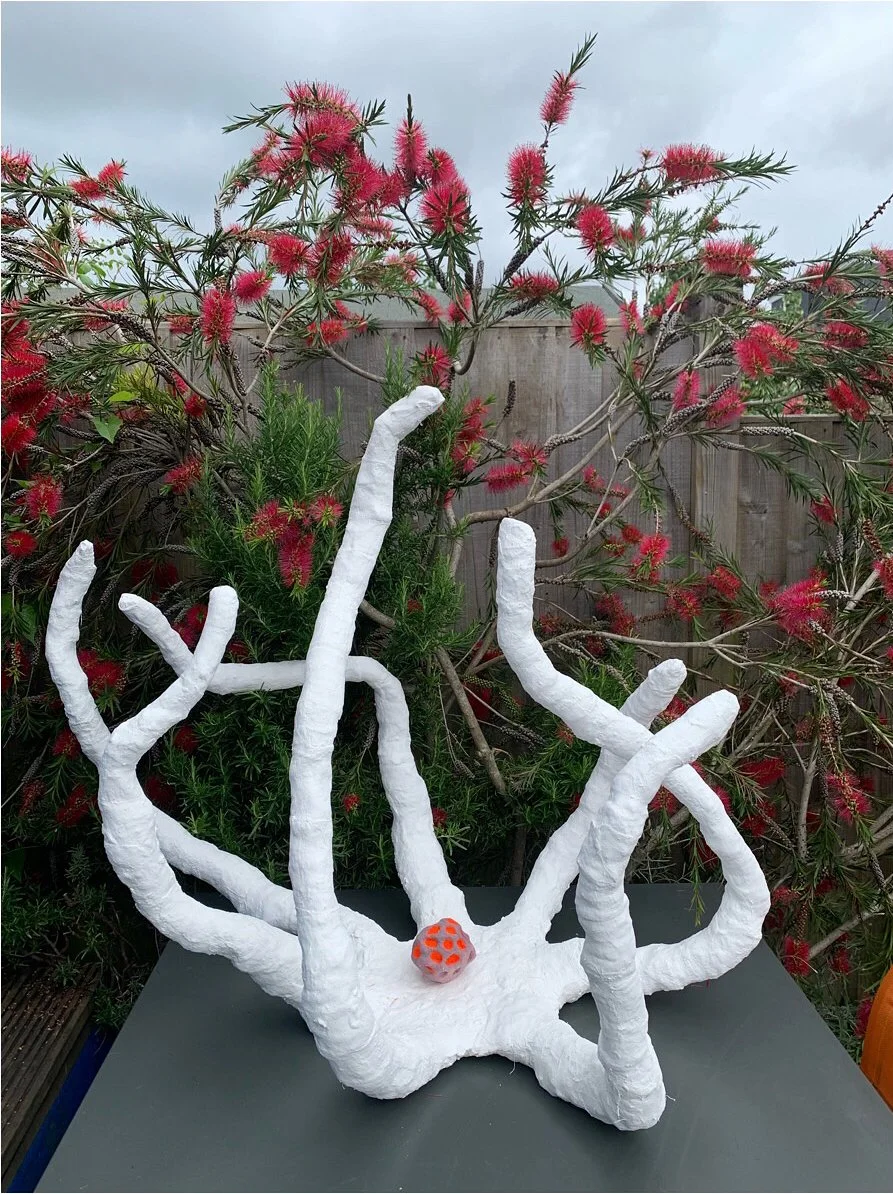
“In the paintings, the shapes are transparent and fluid. They slide, shift and reorganise themselves into new forms. Sculpture allows me to pause that movement temporarily.”
Justine Formentelli
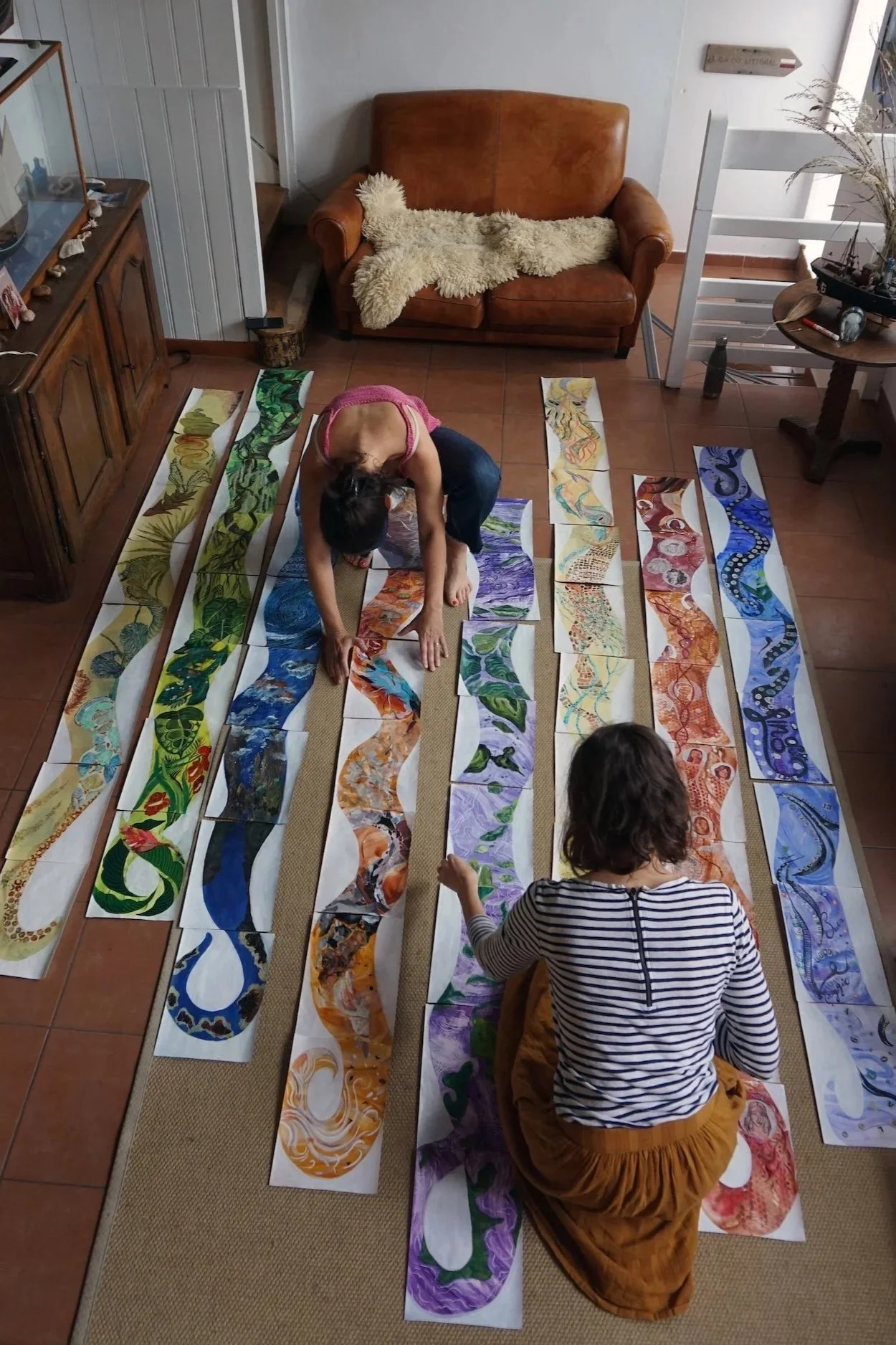
I am also interested in how this relates to your Sister Octopi project - what discoveries did you make or mysteries were revealed through this collaborative artwork?
Sister Octopi was a collaborative project that began in 2017, following the loss of a brother and cousin in close succession. Devastated and searching for a way through grief, Justine and her cousin, Dubai-based artist Natalya Konforti, began a transatlantic artistic correspondence that explored themes of identity, belonging, and adaptation, paying tribute to the strength and resilience of sisterhood in the face of loss and tragedy.
My cousin, the Dubai-based artist Natalya Konforti, and I began a transatlantic artistic correspondence as a way of processing this enormous grief and trying to make sense of an ongoing tragedy within our family.
My brother’s suicide was not the first in the family. One of his cousins had died the previous year, and three of our uncles had also taken their own lives in earlier decades. Natalya and I found ourselves focusing on the women in the family, particularly the pairs of sisters who drew strength from one another. We also chose the octopus as a kind of animal totem for our strange, complex and resilient family.
Through the project, we used natural forms and phenomena, explored through different textures, materials and palettes, to give shape to difficult mental and emotional states. It allowed us to approach experiences that were almost impossible to describe directly.
The research into texture has certainly seeped into my wider practice, but the project’s format was also very important. It consisted of sixteen scrolls, each made from eight A4 sheets, and reinforced my interest in multiplying forms and creating immersive environments.
One of the moments that moved us most happened during one of the exhibitions in Dubai. A visitor stood between two of the suspended scrolls and told us that he felt embraced and held. That was incredibly meaningful because it suggested that the work had moved beyond our personal story and created a physical and emotional experience for someone else.
Can you speak further on the strength and resilience of sisterhood in your family?
The project made me think more deeply about the ways women in our family have supported one another through very difficult circumstances. There are several pairs of sisters in the family, and that bond became an important counterpoint to the loss and instability we were exploring.
For Natalya and me, making the work together was also a way of creating a new form of sisterhood between cousins. We were working across different countries, exchanging images, ideas and materials, and gradually inventing our own visual language.
I think the resilience in the project came from recognising vulnerability, rather than trying to present strength as something heroic or unchanging. That is partly why the octopus became such an important image for us. It is vulnerable without a shell, alien-like, highly intelligent and remarkably adaptable. It can change colour and shape, and its multiple limbs seem able to operate independently while still belonging to the same body.
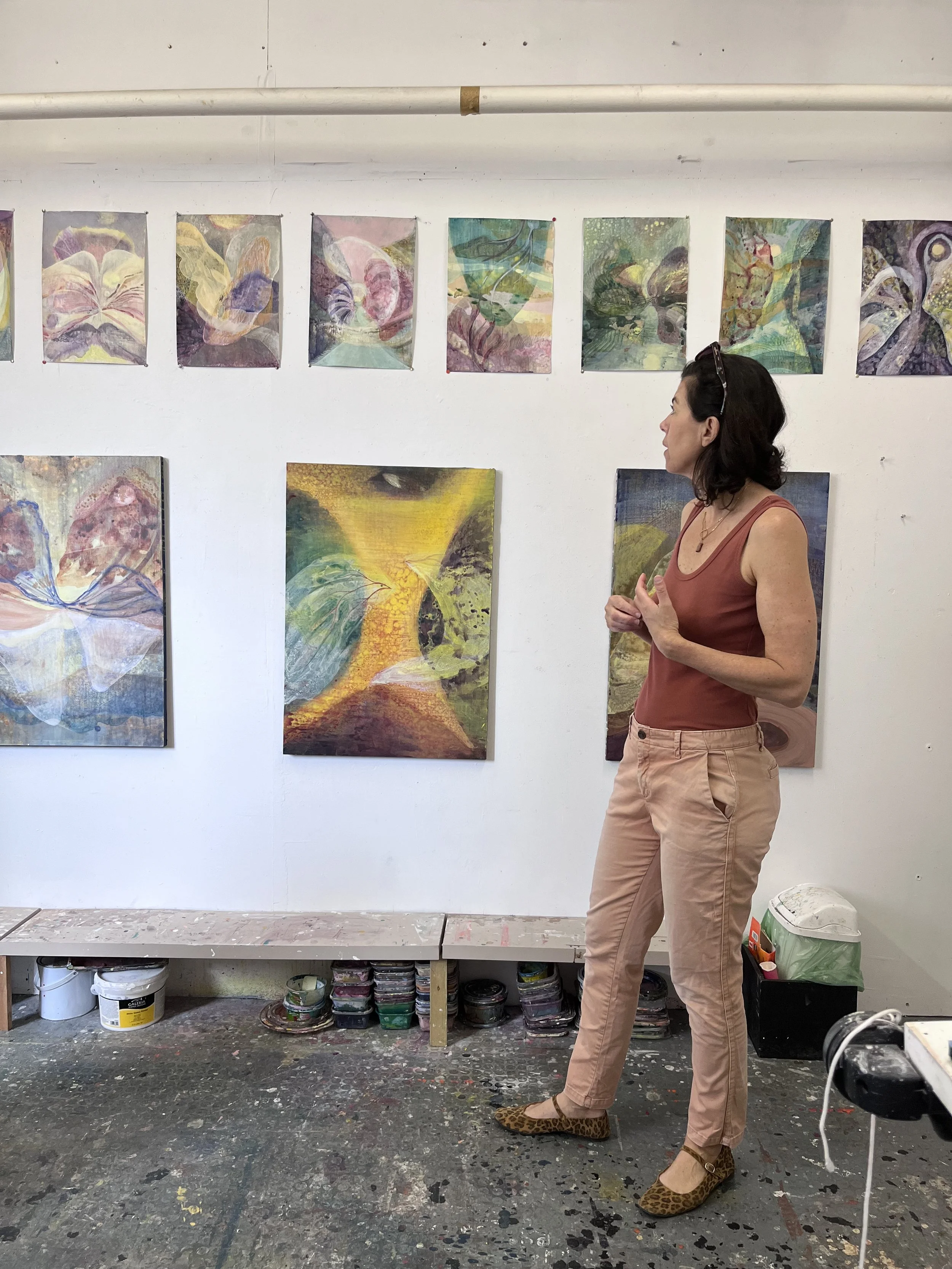
You refer (or have referred) to your work as organic abstraction. Do you work quite intuitively- or how do you approach a painting? Do you work on several pieces at once? Anything else you want to share about your process? (I had sketchbook envy.) How do sketchbooks inform or assist your process?
My process is partly intentional, but also very intuitive. I usually begin with a shape, or a pair of shapes, that I want to investigate across different environments.
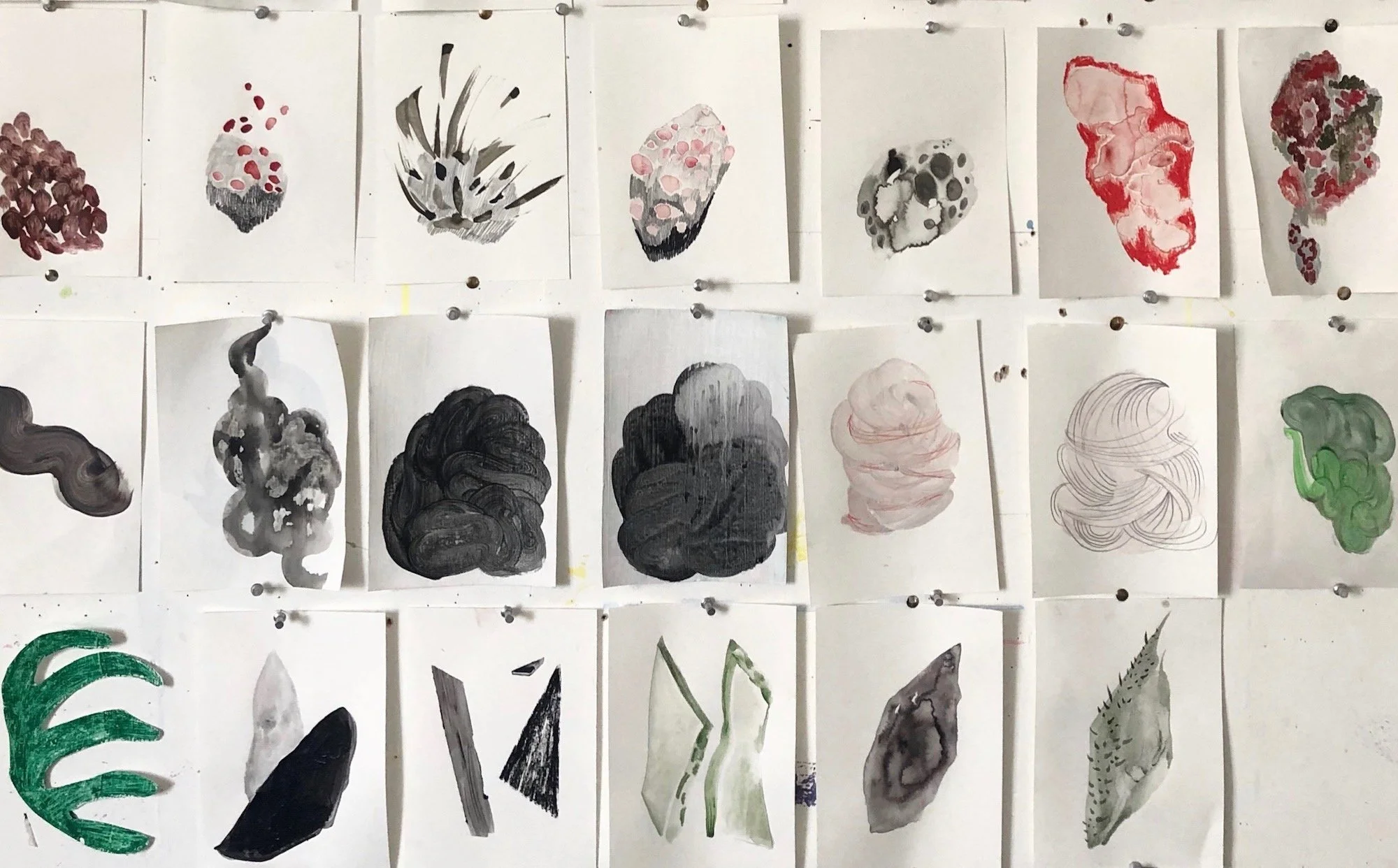
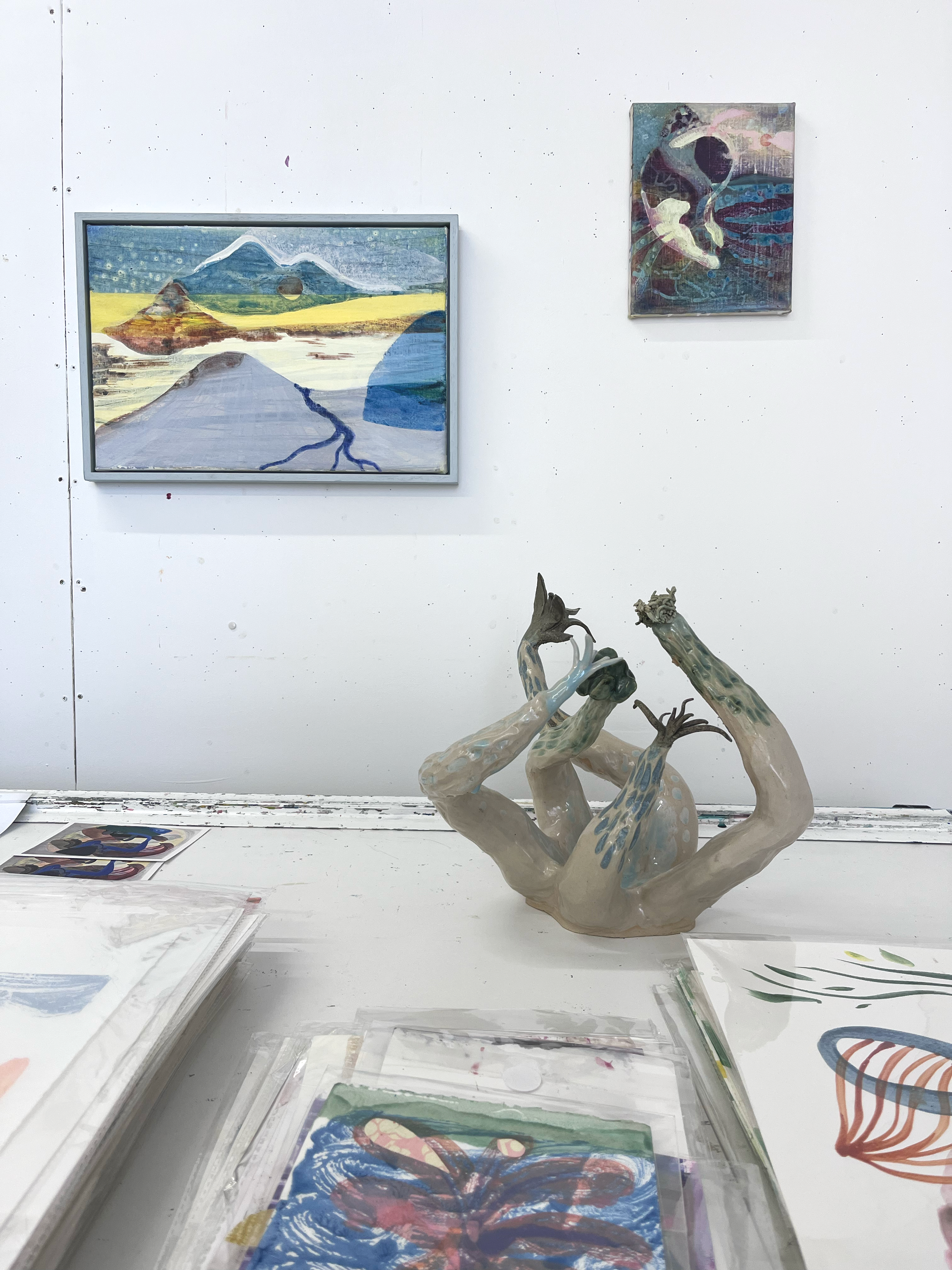
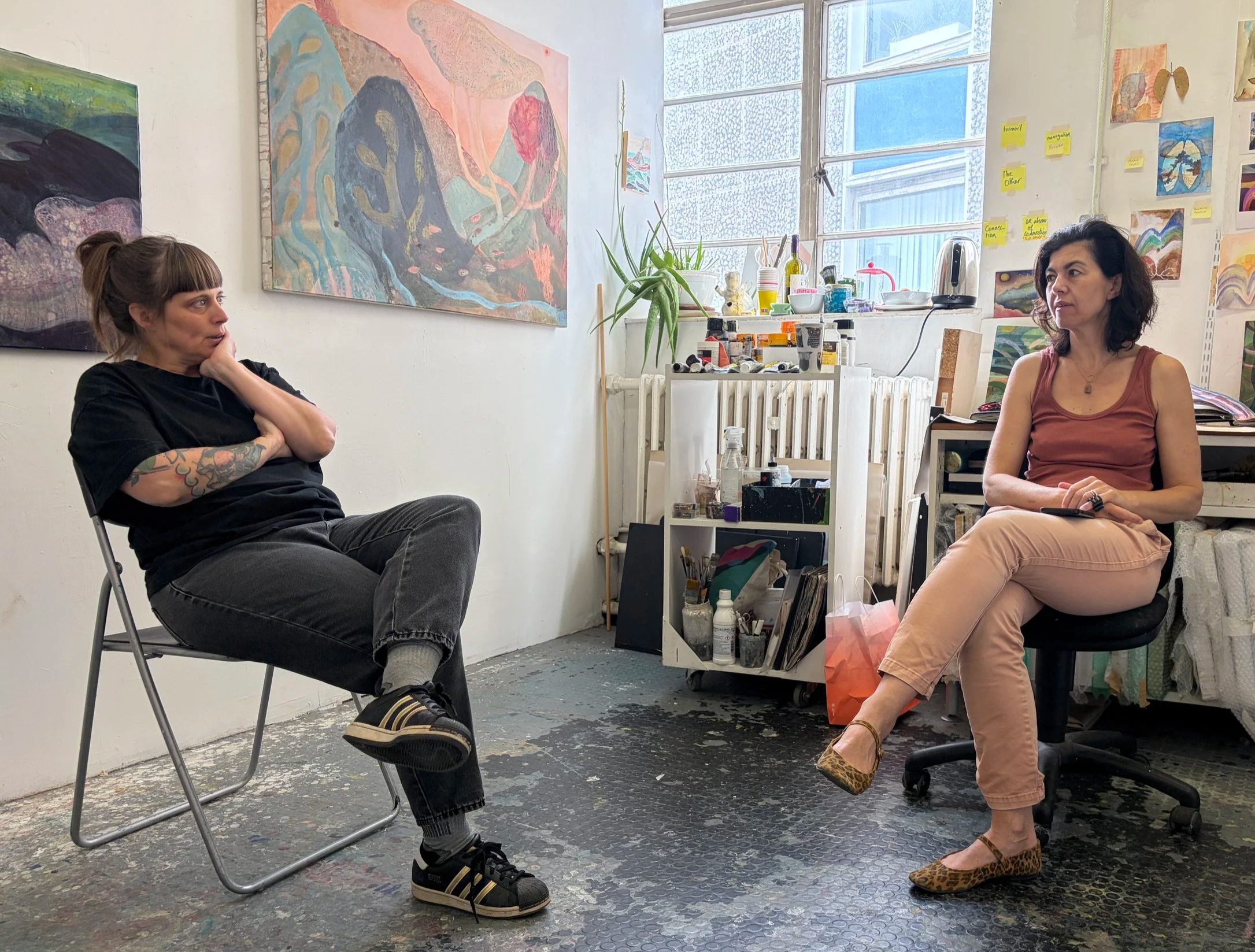
Most of the time, I start with a series of works on paper. I begin with A4 studies and then move on to more involved A3 works. There are often around a dozen pieces arranged in a grid on the studio wall, and I work on them simultaneously, moving between them and rearranging their order as they evolve.
At the moment, I have a grid of fifteen pieces in the studio. I would like to continue developing it until the series fills the full height of a wall, so that it begins to create a more immersive environment.
Once the paper series is well underway, I move onto larger formats. I want to see what scale does to the compositions, but I also want to engage my body more fully in the act of painting. The marks and decisions change when I can no longer control the whole image from one fixed position.
At some stage, I often feel the urge to materialise a recurring shape as a three-dimensional form. It might become a ceramic bas-relief, a paper-clay sculpture or a structure made from wire and plaster strips. I think this is a way of solidifying my continually evolving vocabulary of shapes into clearer, more definite entities—almost as though I am registering them before they morph into something else.
In the paintings, the shapes are transparent and fluid. They slide, shift and reorganise themselves into new forms. Sculpture allows me to pause that movement temporarily.
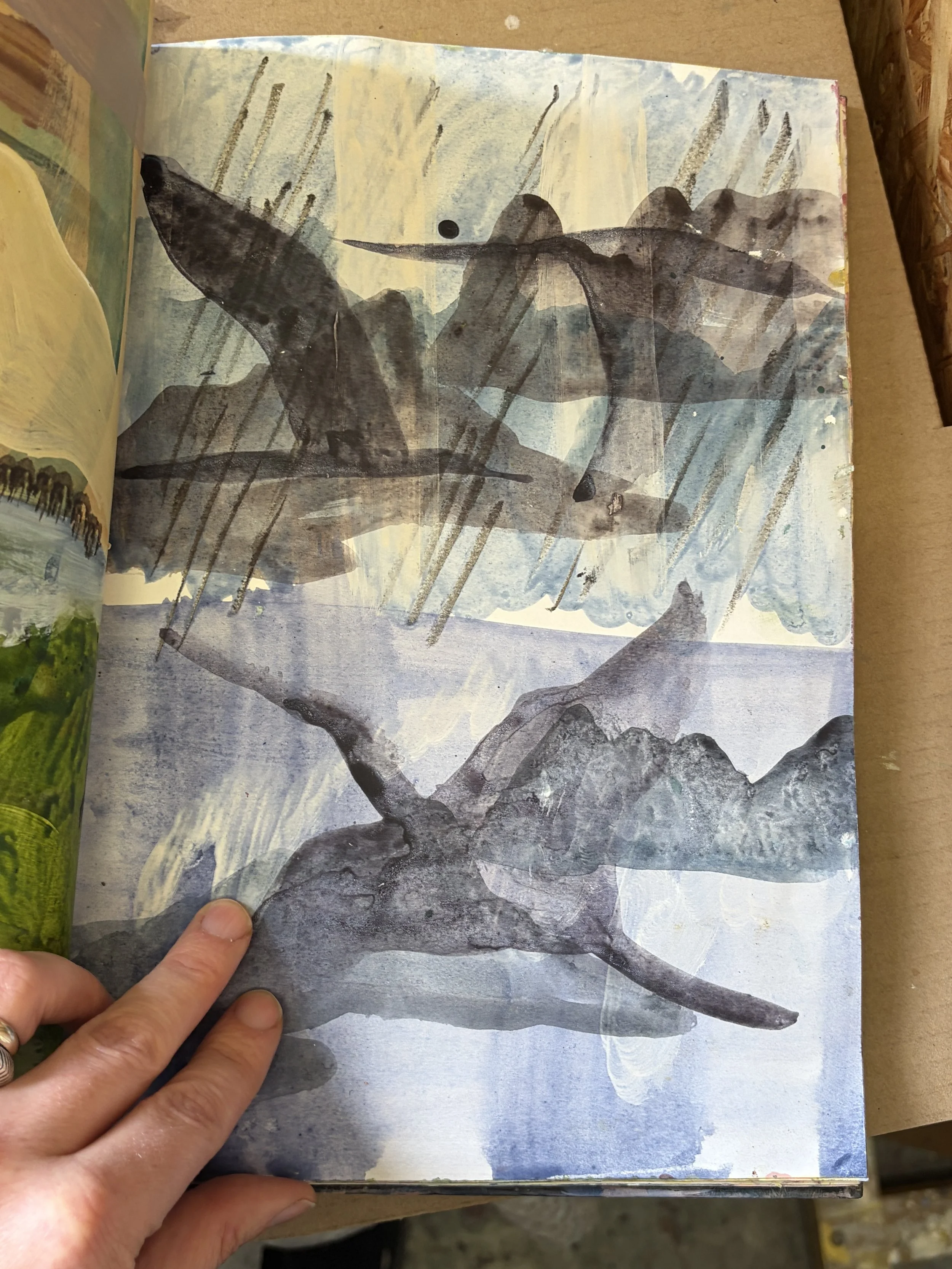
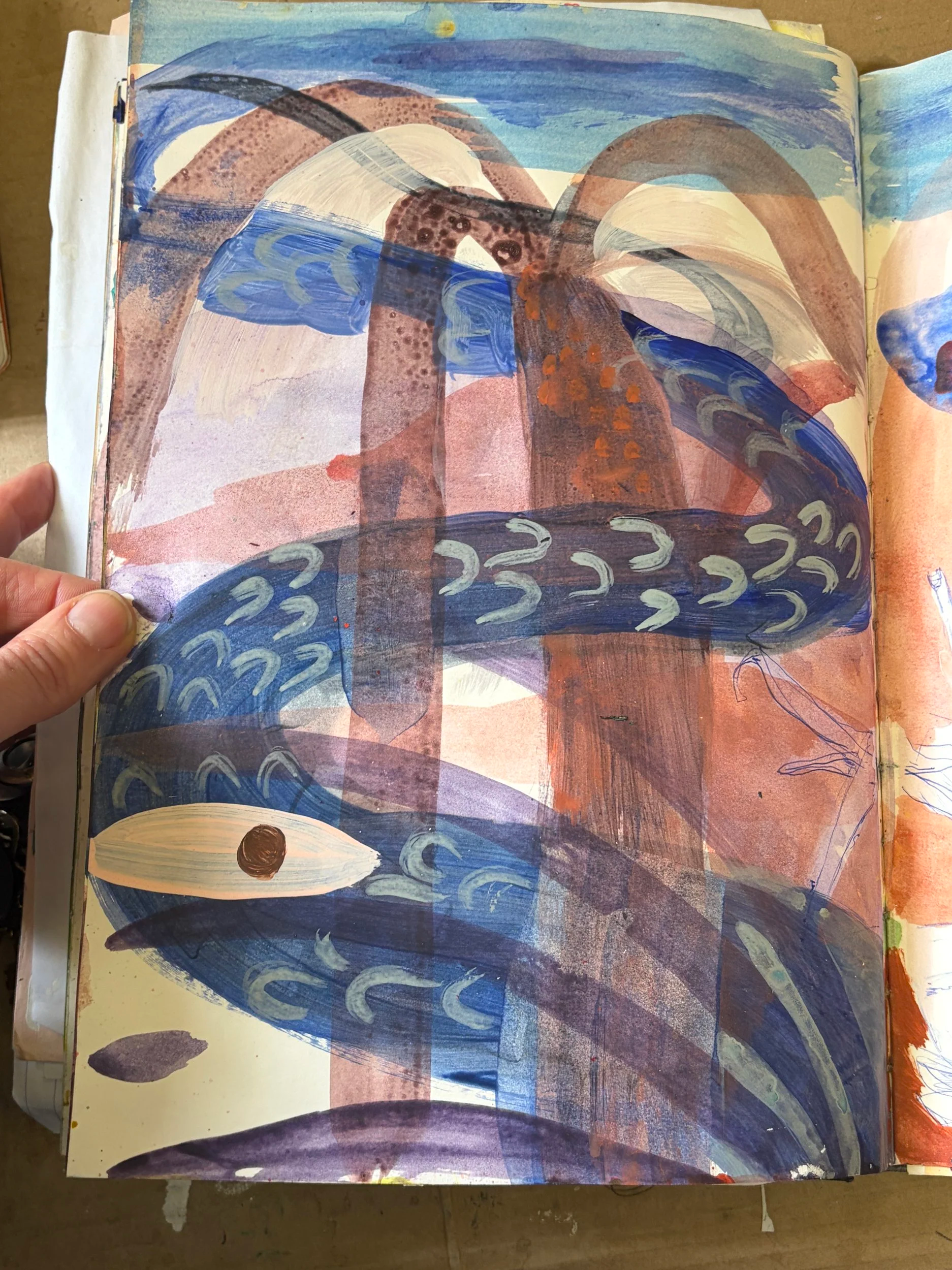
My sketchbooks occasionally inform the development of a particular painting, but mostly they assist the process. When I am stuck with a composition, I sometimes rework it in the sketchbook, and that has led to entirely new pieces in the past. They are also testing grounds for palettes, gestures and material combinations, so they can become very messy. I often return to older pages and work back into the most chaotic ones. I like the feeling that nothing in them is completely finished or wasted.
I do think of the work as having its own visual vocabulary, although that vocabulary is always evolving and expanding.
During lockdown, I made a series of very dense works that were almost bursting with motifs. Afterwards, I decided to create a kind of periodic table of the recurring forms that felt most significant to me. It was an attempt to isolate and simplify them.
The following year, I began rearranging that selected vocabulary through a series called Situations and Permutations. The same elements appeared in slightly different combinations, almost like syllables or fragments that could create new meanings—or different versions of the same story—depending on how they were arranged.
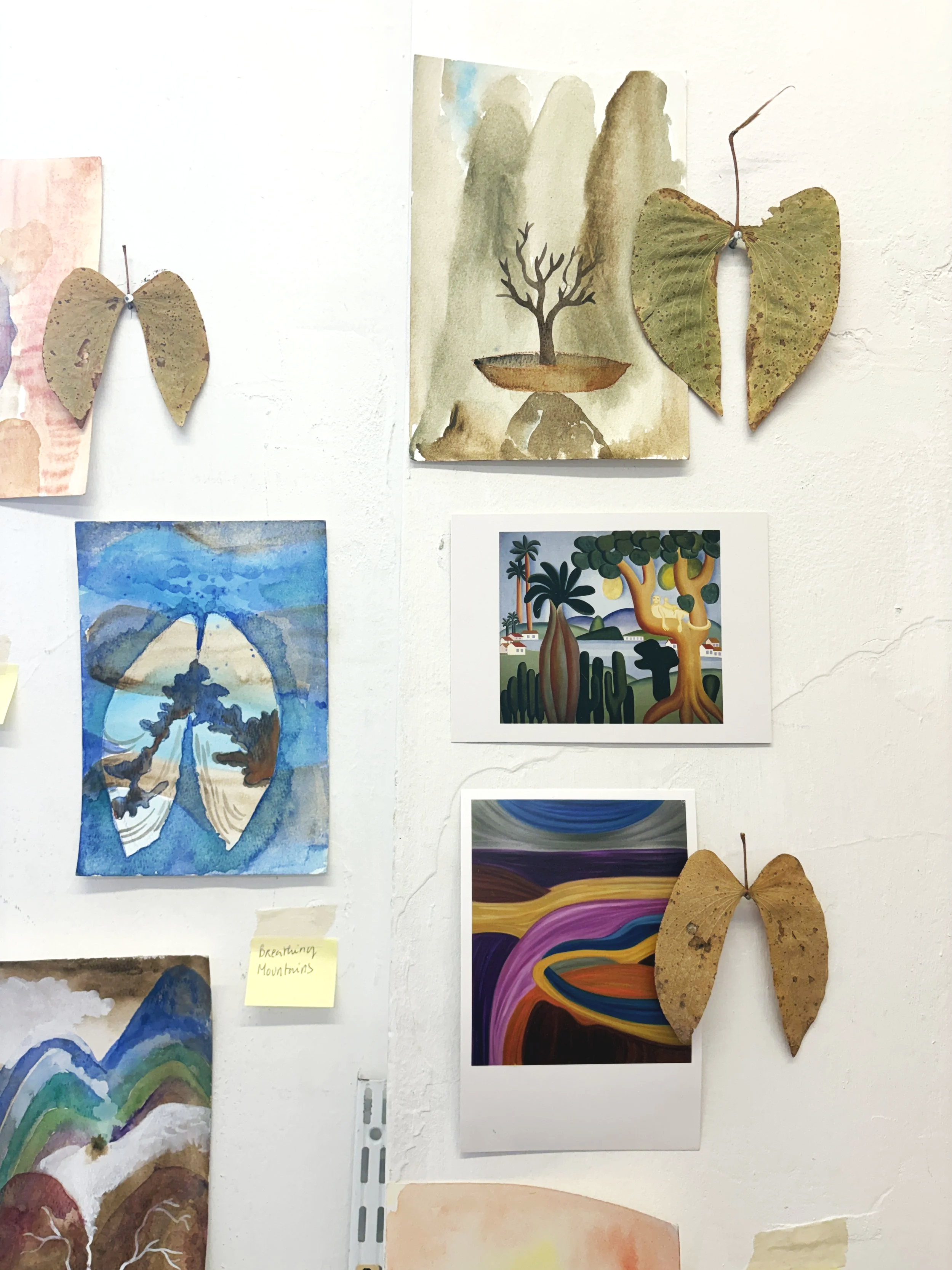
The lung-like or leaf-like form in my current work began quite literally as a lung. I was thinking about breathing as the process that connects the internal body to the external world. I was also interested in the idea of paired forms that depend on one another to function, like lungs, wings or legs. It made me think about symmetry in the human body and in nature.
As I continued painting, the lung shapes began to morph. They became leaves, puddles, seeds, cliffs and other less identifiable things. Eventually, the most important element was no longer what the individual shape represented, but the encounter between two forms: the energy of that meeting and the space between them.
I am currently making a whole series based on the encounter between two shapes. Increasingly, I think of it as a dialogue between two beings, or as a relationship with the Other. There is something in it about our deep human need to connect, and yet how complicated that connection can be when each of us experiences the world through a separate body and mind.
You appear to have your own visual language, recurring shapes and gestures that feel like symbols for a personal cosmology- (a secret language- if you will), for example, the lung/leaf shape that appears as a motif in recent work. Tell us more about how this particular shape evolved and what it means to you. (In Sister Octopi- you also refer to an invented language you share with your cousin- can you say more about this?)
What other shapes or gestures reappear in your work as part of this personal visual language?
Sinuous trajectories appear quite often, suggesting pathways or routes through the composition. Vein-like lines and rivulets recur as connecting forms, linking one shape to another. There are also mountains, rocks, leaves, transparent membranes, wings, spirals, amorphous clouds, shards and thorn-like forms.
I prefer to leave these shapes in a certain state of ambiguity. They are often caught between identities or between states, so that a form might feel bodily, botanical, geological or atmospheric at the same time. I am not particularly interested in fixing what they are. I want the viewer to sense that they might be in the process of becoming something else.
In your interview with Private View Blog, you mention that you are attracted to work that has ‘a mosaic of influences’, which I see as a reflection of your own lived experiences. How do you think your uniquely international upbringing and experiences have influenced you as an artist?
The colours and light of the Caribbean, Réunion Island and Morocco have definitely made their way into my palette. The intensity of the colour can vary depending on the season, the work or my mood, but the search for light is always present.
Living in different places also made me more aware of how environments can alter perception. Landscape, architecture, language and social codes can all change very quickly from one place to another. I think that experience contributed to my interest in shifting forms and unstable boundaries.
Learning the curves of the Arabic alphabet and practising arabesque-like gestures when I was younger also had a strong impact on me. I think this contributed to my attraction to fluid, organic and almost feminine forms, as well as to the rhythm and movement of the line.
Surrealism was another early influence. My father taught a university course on literary Surrealism and introduced me to a wide range of Surrealist works when I was quite young. I was fascinated by the combination of unrelated textures and objects, as well as by collaborative processes such as the exquisite corpse.
I think all of these influences coexist in the work without necessarily being immediately identifiable. They form a kind of accumulated visual memory rather than a single, clearly defined reference.
You must be quite adaptable- but what makes you feel grounded? How is this reflected in your work? (Maybe even just knowing when a work is complete- but even then, how do you know when a work is finished?)
A creative routine makes me feel grounded, and discipline more generally does too. Exercise, language learning, studio work, writing and reading all create a sense of continuity.
I love travelling, but I often find it difficult to return to the studio afterwards and pick up exactly where I left off. I can go through a long period of frustration before I find my rhythm again.
Seeing a series gradually unfold on the studio wall also helps me feel anchored. I tend to see each piece as a member of a very large family. Shaping my immediate environment through the accumulation of these works is perhaps one way of creating a sense of belonging.
Knowing when a piece is finished is more difficult. I often work on several pieces at once, which helps because I can step away from one and return to it with fresher eyes. It generally takes a long time and emerges through many layers, as well as many hours spent simply looking at the work. At some point, it begins to feel resolved. There is a sense of balance and harmony, but it still has to remain alive.
Was there an artist whose work you encountered as a young artist that affected you in some way- for better or worse- something you loved or hated- just out of curiosity? And whose work are you excited about currently? Or is there an exhibition you've seen recently that has stayed with you?
Matisse and Frida Kahlo were probably the first artists I fell in love with. With Matisse, it was the colour and the fluidity of the line. With Kahlo, it was the intensely personal and diaristic relationship to painting.
In my late teens, I remember visiting a Paul Klee exhibition and being drawn to his loose grid paintings. Afterwards, I began filling grids with different patterns myself. It is still an exercise I love and occasionally use in my teaching.
I also remember having a very strong experience in front of Howard Hodgkin’s paintings, particularly After Visiting David Hockney (Second Version) and Rain. I had the sensation of being invited into a landscape that might shelter me. It felt as though I could physically climb into the painting.
More recently, I was very taken by Hurvin Anderson’s exhibition at Tate Britain. I was struck by his tropical palette and by the extraordinary range of his marks, from the graphic murmuration of foliage to abstract drips, rectangles, vertiginous walls of vegetation and lace-like screens painted in incredible detail. There is such abundance and texture in his paintings, but also a real sense of restraint. I was also drawn to the way he looks at place through the perspective of someone who is connected to it but also slightly outside it. That tension between belonging and distance resonated strongly with me.
What would be your dream project or exhibition? Is there any particular space/gallery that you would like to show your work? Any potential collaborators that you’d like to partner with?
My dream project would be a solo exhibition bringing together paintings, ceramics, sculptures and perhaps a site-specific mural, with all of the elements contributing to an immersive environment. I imagine the exhibition unfolding through a series of connected spaces, rather than being presented within one conventional white cube. I would like visitors to be able to meander through it, encountering different atmospheres gradually as one room opens onto another. I am currently researching spaces with that kind of architectural character and room-to-room progression. I would be particularly interested in working somewhere where the history, surfaces and structure of the building could enter into dialogue with the work.
That said, I have always dreamt of exhibiting at the Saatchi Gallery. I have visited many exhibitions there, and I often find myself imagining what it would be like to create something monumental within those spacious rooms and across those wide walls. The scale would allow me to push the work much further and explore a more ambitious relationship between painting, sculpture and architecture.
In terms of collaboration, I would be interested in working with an architect or spatial designer to think about how the viewer moves through the exhibition. I could also imagine collaborating with a sound artist, particularly if the sound remained subtle and atmospheric, helping to connect the different spaces without overwhelming the visual work.
Justine Formentelli is a London-based artist whose international upbringing spans the Caribbean, Réunion and Morocco. After studying Fine Art and Illustration at Atlanta College of Art, she spent 11 years in the United States, including working as a production designer at Harper’s Bazaar, before returning to Europe. She graduated with Distinction from the MA Fine Art programme at City & Guilds of London Art School and has exhibited widely across the UK, Europe, the US and Dubai, including at the London Art Fair, Bankside Gallery, Mall Galleries, Migration Museum and The Mayor Gallery. Her work is held in the Soho House Collection and private collections internationally.